In this section, you will find relevant and helpful information about Olympus’ training simulator.
ENDONIX™ simulator is a 3D printed mock-up and offers a combined transfer of knowledge and skills for endoscopy. The GI simulator offers basic to advanced medical education, as well as training on basic scope manipulation, diagnostic endoscopy, and therapeutic endoscopy.
The project was supervised by Prof. Edgar Jaramillo, MD Consultant Gastroenterologist and our external partner Artiness, an Italian agency focused on innovative technologies for medical doctors.
Disclaimer:
- NBI™ Technology is not intended to replace histopathological sampling as a means of diagnosis
- The positions and statements made herein by Prof. Edgar Jaramillo Ersta are based on his experiences, thoughts and opinions.
- Prof. Edgar Jaramillo Ersta is a paid consultant of the Olympus Corporation.
- This simulator is provided solely for training and educational purposes and is not a medical device. It is not intended for diagnosis, treatment, or clinical decision‑making, and simulator performance should not be interpreted as clinical performance of the actual product. Scenarios shown may not reflect all real‑world conditions, and users should always refer to the device’s official labeling for complete indications, instructions, and safety information.

Quick Reference Guide
ENDONIX™ Simulator Development History
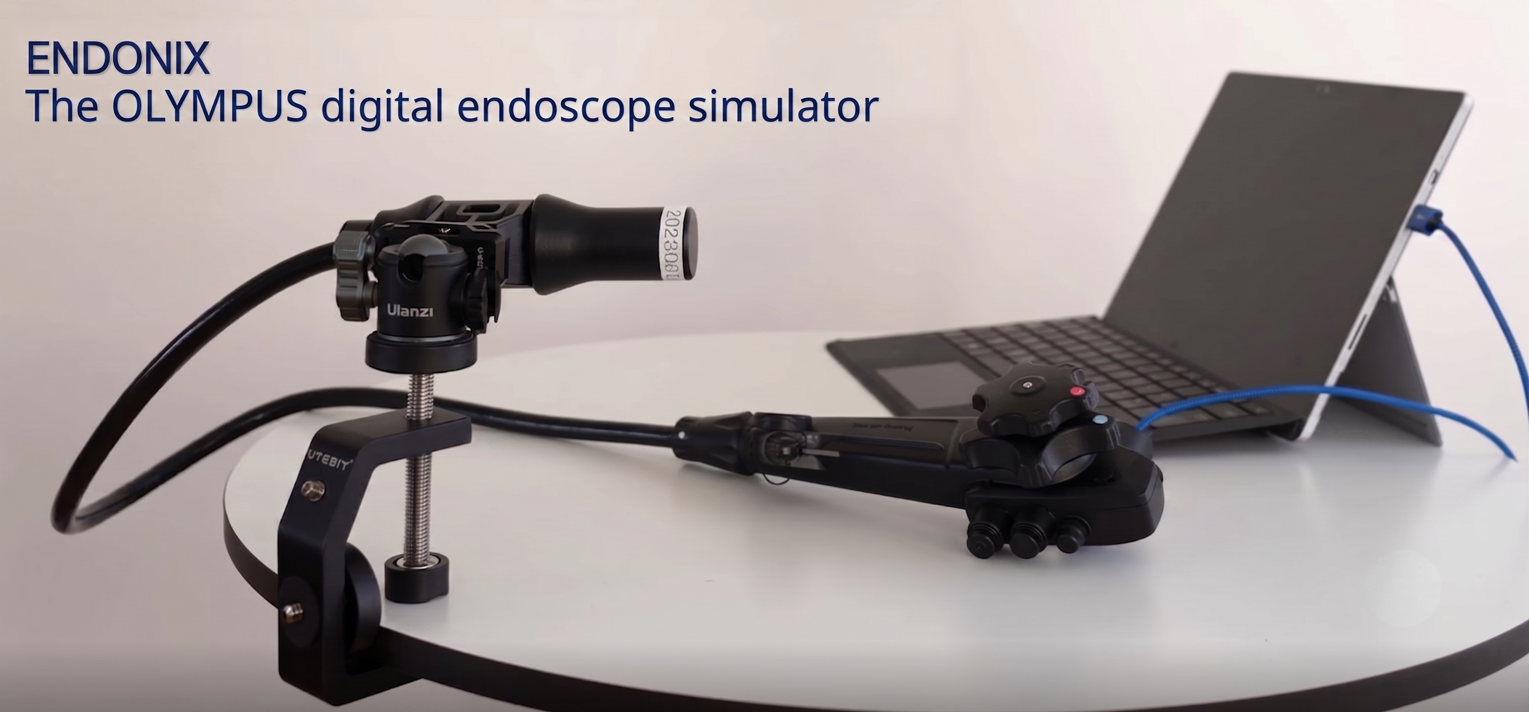
Our goal is to support safe, effective endoscopy practices by expanding access to comprehensive, educational training for endoscopists
The simulator lets users practice a range of endoscopic techniques in an engaging, game-like environment, using an endoscope-inspired controller modeled after familiar handheld gaming devices.
ENDONIX™ stands for = ENDOscope + electroNIcs + eXperience
We explored the idea of endoscopic training through a game-like approach and considered whether such a concept would resonate with endoscopists.
It was at this time that the NCC-EPOC (National Cancer Center – Exploratory Oncology Research & Clinical Trial Center) started an industry-academia collaboration initiative, and we had the opportunity to participate as one of its themes.
The validation of this game-like endoscopic training simulator (ENDONIX™ simulator) started with Dr. Haruhisa Suzuki as leader of the NCC side.

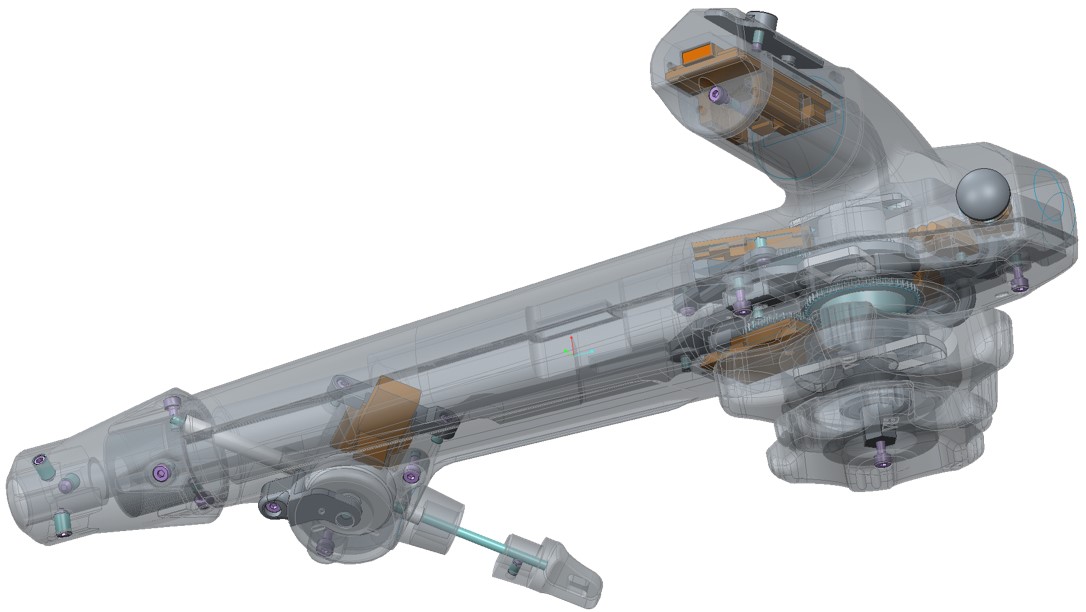
The concept of “game-like endoscopy training,” which we were most concerned about, was very favorably received. In fact, the NCC doctors positively evaluated it as a good way to concentrate on the difficult manipulations in the procedure and enjoy the repetitive practice.
The first challenge we faced was how to describe the “endoscopic-like” characteristics of the simulator.
Whether the ENDONIX™ simulator is perceived simply as a game or as a true training tool depends on how convincingly it captures an “endoscope-like” experience. Elements such as the tactile feel of the control knobs, the handling of the insertion tube, the subtle response delay during manipulation, and the visual representation of the lumen all play a role. However, striving too much for realism can increase complexity and add features that may ultimately compromise the system’s simplicity.
We identified the key movement elements of the procedure and re-presented it using only those core components, preserving simplicity while effectively conveying the essential “endoscope-like” experience


The next challenge was “identifying and communicating the experience,” i.e., what parts of the endoscopic manipulation are important and difficult, and how to express and communicate them as training.
Once we become accustomed to handling an endoscope, it’s easy to forget the challenges we initially faced. When a technique is new, it can be difficult to understand why it feels so hard to perform. Recognizing this gap between experience and unfamiliarity, we set out to find ways to help bridge it.
The first thing we did was to identify which manipulations novice endoscopists find difficult in which situations. Various training apps (games) were prototyped, and data was obtained from OLYMPUS employees who may not have had prior experience with endoscopic manipulations. Among the candidate training apps (games), we selected only those that were difficult for beginners to learn yet show improvement with continued practice.
Second, no matter how good beginners become in manipulating an endoscope at these apps (games), it is meaningless if it is not useful in actual clinical practice. Therefore, we asked NCC Experts to actually experience the training apps (games) to make sure that it could reproduce clinical situations and guide novices to the correct manipulation and made modifications if necessary. In addition, NCC conducted an independent evaluation study on the training effects of training apps (games) and confirmed that endoscopic manipulation improved in novice trainees.
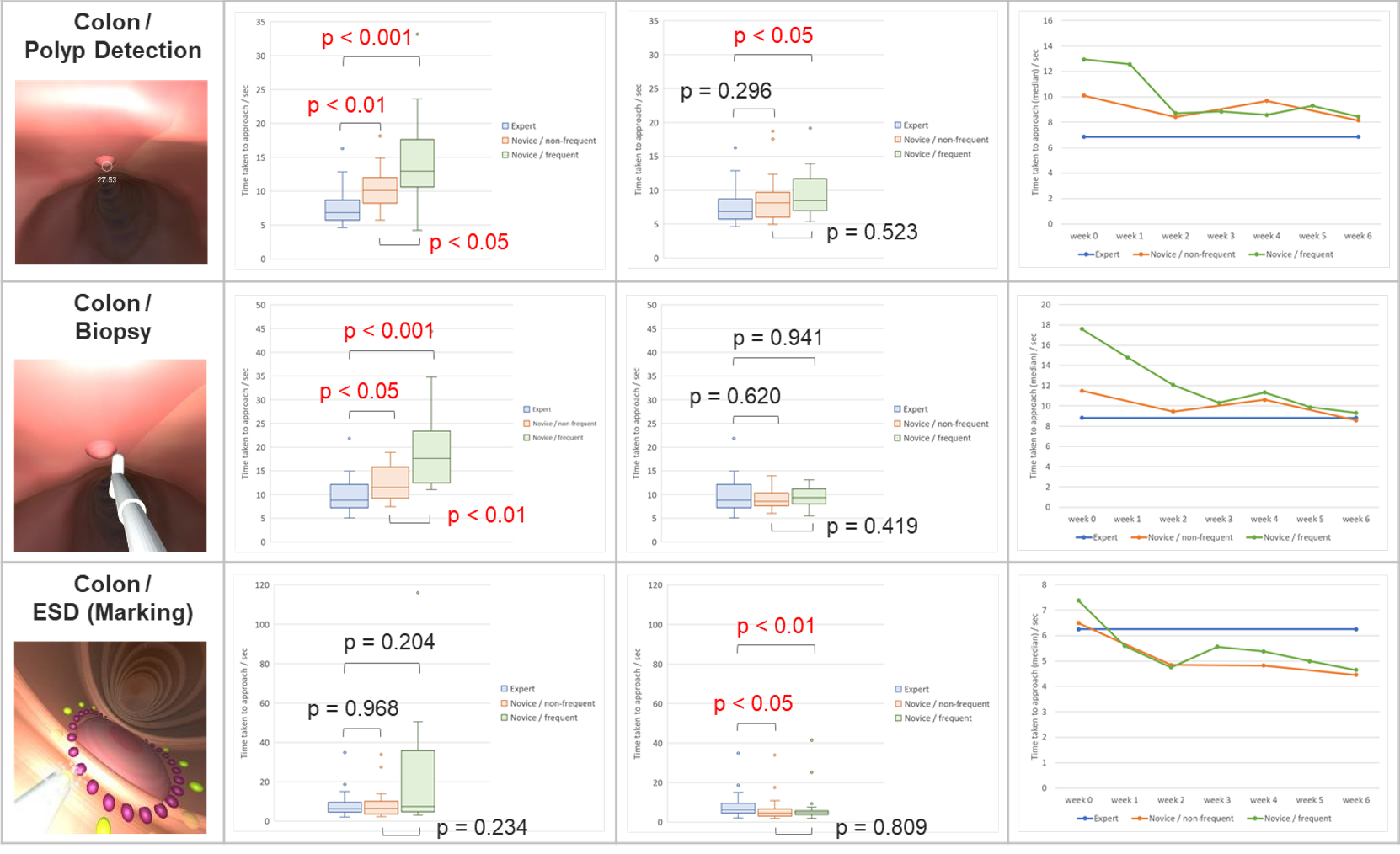
The ENDONIX™ simulator was created through these processes to assist endoscopists with learning essential endoscopic procedures. Yet there are still areas where the quality and quantity of content, functionality, and performance are not sufficient, we will continue to verify and improve them so that we can provide more efficient training to more endoscopists.

Finally, I would like to express my sincere gratitude to Dr. Haruhisa Suzuki and all those involved at NCC for warmly accepting such a challenging development theme and for their guidance.
- Content Type